Issue 3, 2026
In this issue:
- Funding News: The DIAN Observational Study
- Rising Together in London
- Steering the DIAN Observational Study
- Two Research Opportunities for Caregivers and Care Recipient/Partner Pairs
- Caregiver Resource: Rethinking Home Safety Video Presentation
- Alzheimer’s Research in the Media
- Recent DIAN and Affiliated Publications
The DIAN EXR Newsletter is distributed by the Dominantly Inherited Alzheimer Network Expanded Registry (DIAN EXR) and WashU Medicine Department of Neurology
Contact the editor: If you have an idea for a story or have questions about the information in this newsletter, please contact Jamie Bartzel at bartzel@wustl.edu.
Funding News: The DIAN Observational Study
The DIAN Observational Study received funding for the next 5 years from the National Institute of Aging (NIA). This is incredibly important news and acknowledges the NIA’s continued partnership and recognition of the importance of Dominantly Inherited Alzheimer Disease in understanding and treating Alzheimer’s disease. This is also the result of tremendous amounts of work, resilience, and advocacy from the DIAN study Core leaders, DIAN Study site investigators and staff, DIAN participants, DIAD families, and NIA members (Drs. John Hsiao and Laurie Ryan).
The DIAN ART trial is fundamentally dependent on the DIAN Observational study, and this funding will now ensure that ART participants will continue to undergo assessments as part of the DIAN Observational study and help us understand how amyloid immunotherapy treatment affects the disease course relative to the natural progression.
Rising Together in London
In the midst of a historic heat wave, DIAD family members, caregivers, researchers, and clinicians gathered in London for the 2026 DIAD Family Conference. Held on Saturday, July 11, the Family Conference brought families and professionals together for a day of scientific presentations, family perspectives, and socializing.
Saturday morning presentations featured a keynote address from Haruo Naito, CEO of Eisai Co., Ltd., who shared the importance of the partnership between DIAN and Eisai in the fight against Alzheimer’s disease. Dr. Ross Paterson of University College London spoke about mechanics of Phase 1b trial design, followed by a panel question-and-answer session about trial logistics and the drug discovery process. A panel of family members shared their experiences with advocacy: ranging from petitioning government organizations for better treatment options to helping a family member navigate symptoms with dignity and autonomy. Finally, Drs. Randall Bateman and Eric McDade shared DIAN-Trials Unit updates.
Lunchtime allowed family members to mingle with professional guests, and the afternoon was filled with informal discussion groups. Practical support session topics ranged from caregiving, to deciding whether and when to pursue genetic testing, to fertility planning, to end-of-life decision-making. Research team members were on hand for an informal talkback about the science of DIAD. In addition to the conference programming, the nonprofit advocacy organization Youngtimers hosted social events, such as a Friday afternoon tea, Friday night dinner, a Saturday night reception, and a post-conference Sunday breakfast. This mix of structured and informal events allowed for learning, socializing, and connection among family members from across the world, including impromptu pub visits together to experience England’s quarter-final match of the World Cup!
The 2026 conference theme, Rising Together, highlighted the many forms that advocacy can take. Family members described their commitment to ensuring that loved ones’ wishes are followed. Supportive friends and research participants discussed efforts to petition lawmakers and regulatory agencies for expanded research and treatment options. Researchers and pharmaceutical professionals shared investments of time and money into new discoveries. And attendees offered each other advice and perspective on challenges from fertility planning, to caregiving, to genetic testing, to end-of-life decision making. In every corner of the crowded conference venue, advocacy was on full display.
Videos of all morning conference presentations are available online (for 2026 and prior years). And to answer the question, “When is the next Family Conference?”—stay tuned! Planning for future family gatherings depends on logistics as well as funding. (You can make a gift to help ensure the future of Family Conferences.) News about coming events will be shared with members of the DIAN Expanded Registry as soon as it’s available.
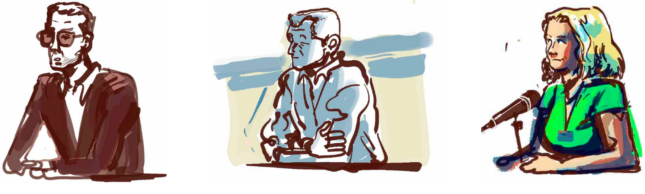
Pictured: scientific panelists Prof. Johannes Levin, Prof. Nick Fox, and Dr. Fiona Elwood, as drawn by audience member Fafah Togora
Steering the DIAN Observational Study
The DIAN Observational Study (DIAN Obs) has enrolled participants since 2008. Of course, before a study can begin, it must be designed—and DIAN Obs brought together a unique group of individuals whose experiences shaped the study. The resulting DIAN Obs Steering Committee continues to advise study leadership, nearly two decades later. I sat down with DIAN Obs Executive Director Dr. Alisha Daniels to learn about the committee’s past and its future.
Jamie Bartzel: Can you provide a brief history of the DIAN Obs Steering Committee?
Alisha Daniels: The committee was born from the idea that DIAN Obs needed stakeholders with differing perspectives: site leaders, family members, bioethicists, US National Institutes of Health and Food & Drug Administration officials, core leaders and investigators at WashU Medicine. This group would contribute to the study design and act as a governing body and first met in Chicago, USA in 2008.
JB: And how has the Committee evolved over time?
AD: The group moved from providing guidance and structure to being a global think tank for this disease. DIAN Obs covers 23 sites (and counting) on 5 continents. DIAN Obs transitioned from knowing where DIAD is found to discovering it in new places. Today, the Steering Committee contributes to grant applications, steers the direction of new science and future leadership, and ensures transition plans. And families have shaped DIAN Obs from the beginning, giving perspective about the impact of participation and the urgency of research progress.
The current Steering Committee holds 1 in-person and 3 virtual meetings per year. It focuses on participant feedback and policy issues, shares new discoveries, and discusses procedure changes. Meetings incorporate an in-depth feedback process, and the voting mechanism allows members to change policies of the study itself.
JB: You mention that DIAN Obs has shifted over time. How have the study’s goals changed?
AD: DIAN Obs began as a standardized protocol that collected information to provide longitudinal data on the DIAN population to understand when the disease begins to develop. In the previous and current grant cycles, the study has added a focus on generating new scientific breakthroughs. Looking ahead, DIAN Obs will build on its longitudinal foundation to drive new discoveries, identify targets for disease prevention, and translate findings into meaningful advances for DIAD families and the broader Alzheimer’s disease community.
JB: Let’s dream about the future! What would you like to see happen, as Alzheimer’s treatments become available?
AD: I want to keep identifying regions and groups with limited research and treatment access, bringing people in so they have a voice. We want to learn more about the differing mutation variants and sources of resilience; then we’ll have a more mature understanding of different treatments’ impact. We learn, evaluate, and keep moving forward. We don’t just get our answer and stop.
JB: What do you want to say to DIAN Obs participants?
AD: Thank you! Thank you to those who have provided such valuable feedback and insight. Without your work, we wouldn’t be as successful as we are. You’re living with the disease, volunteering in studies, taking additional time away from your families, to be a voice for your community. There are so many people working toward a common goal.
Any participants who have concerns or difficulties during their time in DIAN Obs: talk to your principal investigator (PI) directly. All PIs have a voice in the Steering Committee, and they’re all approachable—
JB: It may not always feel that way for study participants. It can be intimidating to approach a PI.
AD: Absolutely. But PIs want to hear from you, and they directly advocate for study participants. Each site, each PI, has a seat at the table when decisions are made. And PIs can’t help if they don’t know where there are issues. The Steering Committee evaluates concerns: is this a single or repeat issue; is it local or regional? Then we can evaluate potential changes. Feedback is shared with PIs and study coordinators during regular site calls and ongoing training and reminders.
JB: And what would you say to other investigators who are designing studies?
AD: Engage participants before you start writing the protocol. Clinicians and investigators have their own perspectives; their population is a resource as you formulate ideas. Your study doesn’t work if the population doesn’t buy in. If this engagement model doesn’t exist at your institution, talk to your leadership—look at existing models, like DIAN!
You know that participants are stakeholders. Make them part of study development so you’ll have maximum success.
JB: How can DIAD family members get involved in the Obs Steering Committee?
AD: The DIAN Observational Study welcomes interest from DIAD family members who would like to serve on the DIAN Obs Steering Committee. By sharing your experiences and perspectives, you can help guide study priorities and ensure that the voices of families remain central to DIAN’s research and decision-making. If interested, please reach out to the DIAN Obs Coordinating Center at: NEURO-DIANCoordinatingCenter@email.wustl.edu
JB: Thank you for this conversation and your care for research participants!
Two Research Opportunities for Caregivers and Care Recipient/Partner Pairs
How does difficulty swallowing in people with dementia affect the stress and well-being of their caregivers over time? Researchers at the University of Oregon are seeking volunteers in the United States and Canada to share their experience. The goal is to help healthcare professionals better understand families. Learn more about the study at https://eatinglab.uoregon.edu/want-to-participate/. Email Samantha Shune at eatinglab@uoregon.edu or call +1 (541) 346-7494 with questions.
Have you or someone you love been diagnosed with young onset (younger than 65) cognitive impairment or dementia in the last 10 months? Do you and someone you love want help managing stress? You may be a good fit for Resilient Together. This is a short-term program for newly diagnosed patients with young onset cognitive impairment or dementia and their care partner, designed to help support you and your care partner as you manage this diagnosis together. This study is conducted by the Center for Health Outcomes and Interdisciplinary Research at Massachusetts General Hospital and open to people living in the United States. Learn more at https://mghresilienttogether.wixsite.com/welcome. Email mghresilienttogetheryod@mgb.org or call +1 (617) 726-6520 with questions.
Caregiver Resource: Rethinking Home Safety Video Presentation
The Knight Alzheimer Disease Research Center offered a presentation on rethinking home safety and technology for people with dementia in September 2026. This hourlong session provides excellent tips on framing the needs of a person with dementia, improving safety, and centering a person’s dignity and needs as their disease progresses. Access the video recording at https://knightadrc.wustl.edu/center-events/3rd-thursdays/; scroll down to “Previous Sessions,” select “Beyond Grab Bars: Rethinking Home Safety,” and submit the requested information to view.
Alzheimer’s Research in the Media
FDA clears Alzheimer’s blood test developed at Washington University
Three new genetic modifiers connected to risk in Alzheimer’s disease
Dementia rising across Latino populations, multidecade study finds
Global consortium launches AI tools to accelerate Alzheimer’s research, treatments
Recent Publications featuring DIAN Data
For a full list of publications using DIAN Obs and DIAN-TU data, visit PubMed.
DIAN Obs and DIAN-TU data advance the scientific understanding of Alzheimer’s disease. There is a marginal risk that a participant might guess, correctly or incorrectly, information including their own or a family member’s mutation or treatment status from this reporting. We take every step to minimize this risk, but de-identified data may reveal a pattern suggesting a person’s mutation or treatment status. Avoid articles or presentations related to our studies to decrease this risk.
If you are interested in research opportunities,
contact the DIAN Expanded Registry at dianexr@wustl.edu.
The DIAN Expanded Registry is supported by the Alzheimer’s Association, GHR Foundation, an anonymous organization, private donors, the DIAN-TU Pharma Consortium, DIAN-TU industry partners, and the National Institute on Aging of the National Institutes of Health under Award Numbers U19AG102728, U01AG042791, R01AG046179, R01/R56 AG053267, U01AG059798, and R01AG068319. The content is solely the responsibility of the authors and does not necessarily represent the official views of the National Institutes of Health.