Issue 1, 2026
In this issue:
The DIAN EXR Newsletter is distributed by the Dominantly Inherited Alzheimer Network Expanded Registry (DIAN EXR) and WashU Medicine Department of Neurology
Contact the editor: If you have an idea for a story or have questions about the information in this newsletter, please contact Jamie Bartzel at bartzel@wustl.edu.
Hurry Up and Wait!
A challenge of research work is the dynamic of “hurry up and wait.” A team scrambles to submit a grant application before a looming deadline, but the wait for a funding decision can take months. An at-risk member of a DIAD family mails off their genetic testing kit and then waits for the call saying a result is ready. Investigators finalize study protocols, then must wait for the resulting data. Regulatory paperwork is completed so a new study site can begin enrolling participants, but then waiting ensues while the submission is reviewed. A participant enrolls in a clinical trial but waits alongside the study team to learn whether a particular treatment appears promising—and if so, another regulatory submission process must begin before the treatment is available on the market!
I (try to) remind myself that waiting is a privilege of doing important work. Granted, this is easier for me to say that it is for individuals waiting on important discoveries to halt the progression of symptoms in themselves or their loved ones. Thankfully, there is an international crowd applying the “hurry” to “hurry up and wait”: contacting regulators and lawmakers to share their experiences, advocating for funding, building community, enrolling in studies that fuel further discovery, supporting each other. When I feel impatient, I take a deep breath and remind myself of this constant activity happening around me, even though I don’t see it all at the moment.
In this issue, I chat with a DIAN-Trials Unit team member doing important behind-the-scenes work to ensure that trial participants receive their experimental treatments in their homes. If you are also prone to impatience, I invite you to close your eyes, take a deep breath, and picture the web of activity covering the globe: people answering emails, making calls, analyzing genetic data, boarding the train home from their observational study visit, meeting to discuss new drug approaches, undergoing scans, scheduling clinic space, talking to their siblings about their family’s health history, and driving across the miles to give a trial participant a timely injection. In the hurrying or the waiting, you are not alone.
Jamie Bartzel, Editor
Behind the Scenes: Trial Coordination with Dana Burgdorf
Dana Burgdorf, RN works with the DIAN-TU team as a Clinical Research Specialist. She coordinates the home health nurses who go to clinical trial participants’ homes and administer the drugs being studied; Dana also assists with brain donations. We were able to steal half an hour in our office’s busiest conference room to chat about Dana’s work and her passion for our participants.
Jamie Bartzel: Before this job, you were an RN—what sort of nursing did you do?
Dana Burgdorf: I worked in pediatric and adult asthma research, and before that, I was a cardiac step-down unit nurse. I was also a home health nurse for a few years—working with diabetic care, wound care, chronic obstructive pulmonary disease.
JB: And how would you summarize your job now?
DB: I’m a participant advocate on the clinical operations side of running trials, specifically overseeing the home health vendor, and make sure drug administration is as smooth as possible. I prevent interruptions in dosing, like courier issues, for example. I want to make the best experience for participants—they don’t need more stress.
I take my job seriously—being proactive to make the experience meaningful for the participants. I love the work because I use my nursing experience, but also my background in business and project management.
JB: What do you like about your job?
DB: People can receive the study drug in the comfort of their homes, which eases the burden of the trial. Many participants are younger and juggling a lot; this reduces the anxiety of adding trial participation to daily life. If the disease progresses, the trial service allows them to manage their health while still participating in trials that give them hope … research leads to better treatments and outcomes.
JB: What are behind-the-scenes complications of home health nursing that people wouldn’t think of?
DB: Things happen: for example, a huge winter storm was approaching the United States in mid-December of 2025. We reached out to manage disruptions as much as possible, making sure the drug (and nurses) could get to people’s homes.
When I started this job, my biggest surprise was how each area of running a trial is distinct. I didn’t realize how it was all segmented, but then all segments have to come together globally! It takes a lot of hard work from a lot of people. As a nurse, I didn’t think about all that went into setting up these systems—experts in each area capturing data, making sure [the trial drug] is dispensed properly.
JB: And you also help coordinate the logistics of brain donation!
DB: Brain donation is how researchers can learn the most about this disease and these drugs affecting progression. Although it’s a hard topic to discuss, I’m honored to be trusted with these generous donations of brain tissue. I make sure tissue is treated with care and respect—that we receive it in the best condition. It’s an irreplaceable gift.
JB: One especially meaningful experience for me in my job was touring the neuropathology laboratory [where donated brain tissue is examined]. Have you also been able to visit the neuropath lab?
DB: Yes, and I was very emotional! I saw a donation I helped through the process. I was crying—that’s one of our participants—seeing that donation, knowing that the participant could make this incredible contribution. It’s a selfless act.
JB: What would you want study participants to know about what you do?
DB: Our team is made up of a wide variety of individuals who really want to make sure our trials are successful, that we can find the best treatments that are out there. Every participant is important to us. That’s someone’s parent, spouse, sibling, loved one.
Every participant is important to our research—it’s bigger than just them, but their individual role is important. It’s a dedicated team behind them. We want the best outcomes for our participants, and we’re passionate about our jobs. That gets us out of bed.
JB: The work is hard; we have to do it because we love it.
DB: We do. Research gives people hope.
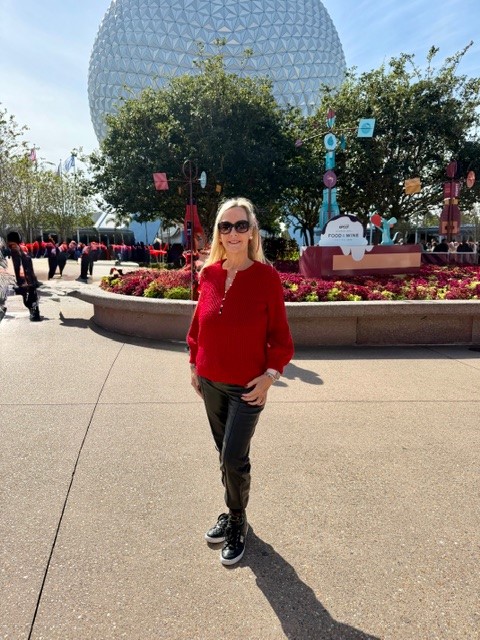
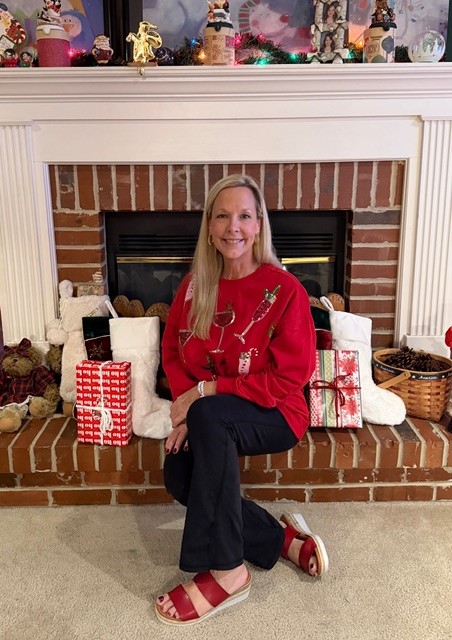
Pictured: Dana in 2025 at the Epcot Center in Florida in November (left) and at home during the Christmas season (right)
DIAD Family Conference 2026
This year’s DIAD Family Conference will be held in London, United Kingdom on Saturday, July 11. Members of the DIAN Expanded Registry with a known connection to a DIAD family have already received an invitation to register. If you would like more information about the conference, email dianexr@wustl.edu. Information about livestreaming will be sent to members of the DIAN Expanded Registry closer to the event date.
View past conference agendas and videos online at https://dian.wustl.edu/for-families/family-conferences/past-conferences/.
Research Opportunity for Caregivers
The Center for Health Outcomes and Interdisciplinary Research (CHOIR) and the Frontotemporal Disorders Unit at Massachusetts General Hospital in Boston, Massachusetts is researching behavioral intervention to reduce emotional distress among care dyads facing young onset dementias (including those with DIAD). This study is for you if you or someone you love has been diagnosed with young onset cognitive impairment or dementia in the last 6 months and want help managing stress. Study participation involves 7 virtual sessions with a clinician, through Zoom. Learn more details at https://mghresilienttogether.wixsite.com/welcome or email mghresilienttogetheryod@mgb.org with questions.
Resources for Families and Caregivers
The Knight Alzheimer’s Disease Research Center at WashU offers monthly webinars, including a presentation by Lorenzo’s House about Early Onset Dementia in December 2025. An excellent Top 10 list of tips for caregivers was also presented in January 2026. Find all videos (and sign up for future email notifications!) at https://knightadrc.wustl.edu/center-events/3rd-thursdays/.
US advocacy group Voices of Alzheimer’s has compiled A Care Partner’s Guide to Behavioral Symptoms in Alzheimer’s, which offers helpful context and advice for different types of symptoms. Access this guide at https://www.voa-foundation.org/care-partners-guide.
Primary Prevention Site Updates
DIAN-TU-002 Primary Prevention continues its enrollment in 2026 in Argentina, Australia, Canada, Colombia, the United Kingdom, and the United States. The following countries are planned to begin enrollment on the following timelines (pending all regulatory approvals):
Quarter 2, 2026: Brazil, New Zealand
Quarter 2, 2026: France, Germany, Italy, Netherlands, Spain
Quarter 3, 2026: Mexico
Are you interested in trial participation? Contact dianexr@wustl.edu.
Alzheimer’s in the Media
NPR science correspondent Jon Hamilton discusses the importance, and future, of DIAN research with study participants and leadership in this featured interview: These families help scientists find Alzheimer’s treatments. Their network is at risk
Single Test Could Predict Alzheimer’s Symptoms Before They Even Begin
Engineered immune cells help reduce toxic proteins in the brain
Recent DIAN and Affiliated Publications
Dr. Alisha Daniels and coauthors detail the longitudinal resources available through the Dominantly Inherited Alzheimer Network Observational (DIAN Obs) study: 15 years of longitudinal genetic, clinical, cognitive, imaging, and biochemical measures in DIAN
Impact of diagnostic genetic testing for familial dementia: experiences of patients and relatives
Brain volume trajectories in Down syndrome and autosomal dominant Alzheimer’s disease
For a full list of publications using DIAN Obs and DIAN-TU data, visit PubMed.
DIAN Obs and DIAN-TU data advance the scientific understanding of Alzheimer’s disease. There is a marginal risk that a participant might guess, correctly or incorrectly, information including their own or a family member’s mutation or treatment status from this reporting. We take every step to minimize this risk, but de-identified data may reveal a pattern suggesting a person’s mutation or treatment status. Avoid articles or presentations related to our studies to decrease this risk.
If you are interested in research opportunities,
contact the DIAN Expanded Registry at dianexr@wustl.edu.
The DIAN Expanded Registry is supported by the Alzheimer’s Association, GHR Foundation, an anonymous organization, private donors, the DIAN-TU Pharma Consortium, DIAN-TU industry partners, and the National Institute on Aging of the National Institutes of Health under Award Numbers U01AG042791, R01AG046179, R01/R56 AG053267, U01AG059798, and R01AG068319. The content is solely the responsibility of the authors and does not necessarily represent the official views of the National Institutes of Health.